Selected work
Real projects, with the actual problem, approach, and outcome — no placeholder case studies.
Bizflow24
Multi-tenant ERP for consultancies
First clientOCG Bangladesh Ltd.Subsidiary of Oriental Consultants Global Co., Ltd. (Japan)
Bizflow24 is BinaryFlow's own SaaS product — a multi-tenant ERP built around how consultancies actually run: HR, payroll, project tracking, and client invoicing in one platform. OCG Bangladesh Ltd. is its first client, live as the founding tenant.
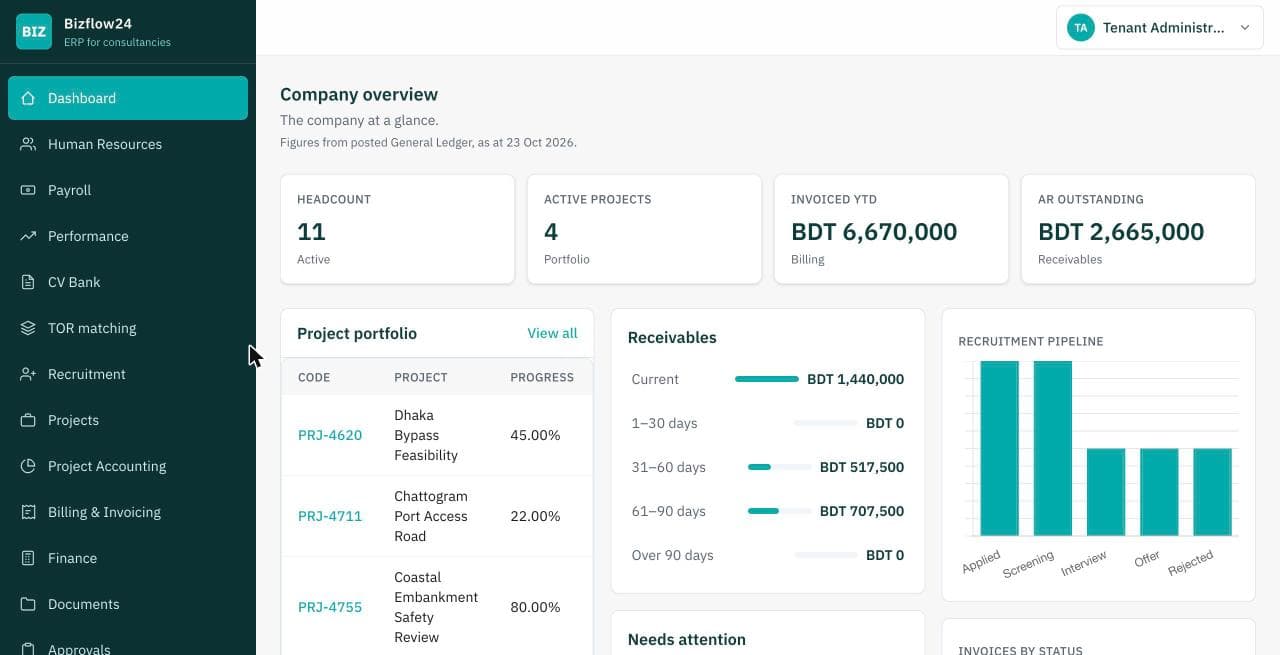
Inside the product
HR & people management
Employee records, attendance, leave, and performance for the whole company — one source of truth for who works where.
Payroll
Salary structures, allowances, and deductions — Bangladesh-ready out of the box, configurable per tenant.
Recruitment, CV bank & TOR matching
A full hiring pipeline plus a searchable CV bank that matches candidates against terms of reference — built for how consultancies win bids.
Projects & project accounting
Portfolio tracking with progress, budgets, and per-project accounting, so delivery and money stay in the same picture.
Billing & invoicing
Client invoices with receivables aging you can actually act on — current, 30, 60, 90 days at a glance.
Finance & general ledger
A proper double-entry ledger with chart of accounts and VAT-oriented defaults — dashboards report posted figures, not estimates.
Documents & approvals
A central document store with approval workflows, so sign-offs leave a trail instead of living in email.
Dashboards & HQ oversight
Company KPIs at a glance for the team — and read-only oversight dashboards for a parent company or headquarters.
The problem
Growing consultancies end up running HR, payroll, project tracking, and client invoicing across disconnected tools and spreadsheets — and off-the-shelf ERPs fit neither consultancy workflows nor local requirements like Bangladesh payroll and VAT. OCG Bangladesh, an engineering consultancy operating under Japan HQ oversight, faced exactly this.
Our approach
We built Bizflow24 as our own multi-tenant SaaS rather than a one-off tool for a single company: shared-database tenancy with strict per-tenant isolation, dual role- and plan-based authorization on every route, read-only HQ oversight dashboards, and a disciplined service/repository architecture — on Laravel, Livewire, MySQL, and Redis.
The outcome
OCG Bangladesh came on board as Bizflow24's first client and runs its day-to-day operations — HR, payroll, projects, and invoicing — as the founding tenant, with Bangladesh-localized defaults (BDT, local statutory setup) and full visibility for the Japan parent. New consultancy tenants onboard onto the same platform without rework.
The engineering underneath
An ERP earns trust with what you can't see in a screenshot. Bizflow24 is built so that correctness is enforced by the architecture — and verified by the test suite — not left to discipline:
- Strict layered architecture — business logic lives in services and every query in repositories, so the web UI and the API are two faces of the same feature and can never drift apart.
- Rules enforced by tests, not convention — automated architecture tests fail the build the moment a layer boundary or localization rule is broken.
- Tenant isolation proven, not assumed — a dedicated test suite verifies, for every tenant-owned table, that one tenant can never read, write, or even enumerate another tenant's data.
- Two independent authorization gates on every protected route — the user's role and the tenant's subscription plan are checked separately, so neither can be bypassed.
- A complete, documented API contract maintained alongside the UI — hundreds of specified requests, ready for future mobile apps and integrations.
Want to see Bizflow24 in action?
Request a demoHave a similar project?
Tell us about it and we'll walk you through how we'd approach it — problem first, scope second.